I want to talk about the anti-AI contingent. This is an interesting issue where there's a lot of pushback. And I want to run some numbers because I, I feel like there's just a high degree of sort of the moral high ground positioning. I'm never going to use this. People don't want to ask me on LinkedIn. They don't debate whether we should drive electric cars or not. Some of us are driving non-optimized CO2 vehicles. But it's not a discussion on LinkedIn. AI, partially because it shows up on LinkedIn, is a discussion. It's a heavy discussion. But there's a moralistic element to it because of the environmental concerns with data center building. And there just seems to be some different pieces to it. So let's walk through the pieces, kind of compare the environmental footprint of AI, where that's coming from, one person's use of a text generation, which I can do on my laptop without the internet connection, have a locally installed LLM. If we're using the smallest amounts of compute through language processing and these other super data heavy concepts of video generation are another deal, maybe we shouldn't lump the two together in our carte blanche reaction. But just kind of want to step through some of these things in terms of the size of the environmental impact for the electricity in your home, your car, your cell phone, your Amazon delivery packages, your lawn mowers, and the AI you might use. And then where the rest of the industry, where industry is using AI, video creation, corporations. And really frame how this environmental impact, and there's the neighborhood conversation, there's noise, there's actual concerns. And there's, it's tied together with this feeling of corporate malfeasance and corporations doing whatever they want without any concern for we the people. Put all that into perspective with some data
How AI Energy Use Stacks Up
I’ll separate everyday text use from image and video generation, model training, and data-center construction. Then I’ll put the energy and emissions alongside household electricity, driving, deliveries, and lawn equipment, while distinguishing global environmental costs from what a neighborhood experiences when a data center arrives.
There's a striking imbalance in the way AI gets discussed environmentally. Someone using ChatGPT to write an email or develop an idea can become the target of an ethical argument about electricity consumption, while driving a gasoline SUV, maintaining a lawn, ordering packages, and streaming television are treated as ordinary life.
Your comparison is worth making, because the environmental impact of a person's everyday use of text AI is dramatically smaller than many of those activities. Yet the aggregate environmental impact of AI infrastructure is becoming substantial.
Both observations can be true. The important questions are where the resources are being consumed, for what purpose, who benefits, who bears the costs, and who gets to decide.
1. What does one person's AI use consume?
Two useful figures published in 2025:
Google Gemini
0.24 Wh
Per median text prompt
Google's measured estimate, including data-center overhead.
ChatGPT
0.34 Wh
Per average query
Sam Altman's reported estimate; methodology not publicly detailed.
Google reported 0.26 milliliters of water and 0.03 grams of CO₂-equivalent emissions for its median Gemini text prompt. OpenAI's CEO reported approximately 0.32 milliliters of water per average ChatGPT query. These figures are provider estimates with different measurement methods, rather than universal figures for all AI use.
Consider a person using ChatGPT 100 times every day for an entire year. At the reported 0.34 Wh per query:
100 text queries per day × 365 days
12.4 kWh/year
Estimated annual electricity consumption for those queries
Share of average US household electricity
0.115%
Compared with approximately 10,791 kWh annually for a US residential electricity customer, using EIA data. This is the marginal electricity estimate for queries, not the full lifecycle impact of AI infrastructure.
That's a useful foundation for your argument. Someone using text AI quite heavily may consume less electricity for their AI requests over a year than many household appliances consume in a few days.
But the distinction between the impact of one user's queries and the infrastructure required to provide the service becomes essential as we broaden the analysis.
2. Comparing everyday activities
The following comparisons use electricity consumed, with gasoline consumption identified separately. That's important because a kilowatt-hour of electricity and a gallon of gasoline have different carbon footprints.
| Activity | Approximate energy use | Comparison |
|---|---|---|
| One ChatGPT text query | 0.34 Wh | Baseline |
| 100 ChatGPT queries | 34 Wh | Less than two full smartphone charges |
| Fully charging a smartphone | 19 Wh | About 56 text queries |
| Streaming one hour of video | 77 Wh | About 226 text queries |
| Running a 100 W television for four hours | 400 Wh | About 1,176 text queries |
| Running a 1,500 W space heater for one hour | 1,500 Wh | About 4,412 text queries |
| Average US household per day | 29,600 Wh | About 87,000 text queries |
Sources: OpenAI's reported query estimate, EPA smartphone charging methodology, IEA streaming research, and EIA household electricity data. Television and heater figures are calculated examples based on stated wattages. Streaming research is from 2020, so current devices and networks may differ.
Here's where the broader comparisons become interesting.
Driving a gasoline car
EPA estimates approximately 393 grams of greenhouse gases per mile for an average gasoline passenger vehicle, including tailpipe CO₂, methane and nitrous oxide.
Using Google's reported 0.03 grams CO₂e per median Gemini text prompt, one mile of gasoline driving produces approximately the same operational/lifecycle-combined emissions reported for 13,100 such prompts. The comparison isn't perfectly equivalent because the AI figure includes a different set of lifecycle boundaries, and the vehicle figure excludes manufacturing and fuel supply impacts.
Nevertheless, the difference in magnitude is enormous.
A gasoline lawn mower illustrates a similar issue. As an illustrative assumption, burning 0.25 gallon of gasoline during an hour of mowing produces about 2.2 kg of CO₂ from combustion alone, before other pollutants or fuel-production emissions. That's using EPA's 8.89 kg of CO₂ per gallon.
Amazon deliveries
A package has an environmental footprint from production, packaging, warehousing, transportation and final delivery. No single emissions value represents every package.
Amazon reported that consolidating Prime deliveries in the US during 2024 avoided approximately 335,000 metric tons of CO₂e and 494 million boxes. That illustrates the potential scale of reducing deliveries, although the avoided emissions cannot be attributed exclusively to each box.
A useful distinction here: society generally accepts that deliveries, driving and lawn maintenance generate emissions in exchange for convenience or economic value. We typically debate their efficiency and regulation rather than expecting people to reject the activities categorically.
3. Text, images and video are very different AI workloads
This is arguably the strongest technical distinction in your argument.
Illustrative energy per generation
| task | Energy |
|---|---|
| Text prompt | 0.34 Wh |
| AI image | 2.9 Wh |
| AI video, lower benchmark | 7.2 Wh |
| AI video, upper benchmark | 322.2 Wh |
Different models and benchmarking methods; figures are illustrative, not standardized product averages.
Text: reported ChatGPT query average. Images: 2024 Luccioni et al. benchmark mean. Videos: ML.ENERGY 2026 benchmark examples. Different workloads, hardware and measurement boundaries prevent direct like-for-like comparisons.
The 2026 ML.ENERGY work found video generations consuming roughly 26 kilojoules to 1.16 megajoules in its tested configurations. That converts to approximately 7–322 Wh for a generated video, depending substantially on model, resolution and frame count.
The difference between writing a paragraph and rendering a video could be hundreds or thousands of times in electricity consumption.
The same argument applies to model design. A large reasoning system might expend substantial computation exploring possible solutions, while a small, task-specific model can complete a classification using relatively little electricity. Research published in Nature illustrated an approximately 16,000-fold difference between an efficient question-answering model and a particularly energy-intensive image model.
Therefore, a categorical objection to AI loses some of the distinctions that matter most for environmental policy.
Your local LLM example
An LLM installed on your laptop can process language without contacting a remote server. That shifts the immediate inference electricity consumption to the device you already own.
For illustration, running a laptop at an additional 30 watts for one hour uses 30 Wh, equivalent in electricity to approximately 88 of the reported average ChatGPT queries.
But local inference is not automatically more efficient. It depends on model size, processing speed, device utilization and whether a cloud server can process many users' requests efficiently. A local model still carries the environmental cost of producing its hardware and training its model.
Research into local language models increasingly measures intelligence per watt, rather than simply equating the largest model with the most useful model.
That is a more productive environmental conversation: How much useful work do we obtain from the energy we consume?
4. The data-center industry is where the numbers become serious
This is the other half of the picture. Individual text prompts may use little electricity, but the infrastructure industry is expanding very rapidly.
Global data-center electricity consumption
| year | TWh annually |
|---|---|
| 2024 actual | 415 |
| 2030 forecast | 945 |
International Energy Agency, Energy and AI, 2025. Includes AI and non-AI data centers.
In 2024, data centers accounted for about 1.5% of global electricity consumption. The IEA projects more than a doubling by 2030, with AI the most important driver of that growth.
And in the United States, the numbers are considerably more striking.
Projected US data-center share of all electricity consumption in 2030
11.8%
Central estimate, with a range of 9.5%–15.3%
Lawrence Berkeley National Laboratory, June 2026 update.
This is a substantial industrial expansion. It is reasonable to question the infrastructure, the economics, the public subsidies, and whether capacity construction is outpacing demonstrable demand.
But one important problem with using these figures to condemn AI generally is that data centers do much more than run generative AI.
They support cloud applications, banking, internet services, storage, enterprise software, streaming infrastructure, advertising, search engines, e-commerce and a considerable amount of conventional corporate computing.
AI is increasingly integrated into these industries, so the boundaries are blurring. Nevertheless, the entire 415 TWh global data-center figure cannot be attributed to ChatGPT or generative AI.
There is also a distinction between training and inference. Training frontier models requires large clusters and concentrated computing investments. Inference occurs whenever trained models are used, across potentially billions of requests. Both contribute, and their relative shares change as usage expands.
Who consumes all this computing?
A useful accounting framework would separate:
| Sector or activity | What generates the demand |
|---|---|
| Individual consumers | Text conversations, search, personal creativity, images and video |
| Corporate productivity | Coding assistants, document processing, analytics, customer support |
| Advertising and entertainment | AI images, video, personalization and content production |
| Industrial and scientific applications | Engineering, research, simulation, prediction and optimization |
| AI developers | Training, experimentation, model evaluation and serving infrastructure |
| Non-AI digital services | Traditional cloud computing, storage, commerce and communications |
We do not yet have sufficiently standardized, publicly disclosed electricity consumption by these categories to assign defensible percentages to each. And many categories overlap.
That absence of transparent reporting is itself a legitimate target of criticism. If the argument is about environmental responsibility, we should know how much electricity companies consume, what they produce with it, and the environmental consequences.
5. What happens to communities where data centers are built?
This is where I think the anti-AI argument becomes considerably stronger.
The objections concern physical infrastructure and who bears the consequences of private decisions.
<AsyncVideoCarousel video_source_data="genui://data/BHDj" candidate_ids={["video2","video0","video1"]}/>
Local news video reports showing the kinds of data-center noise concerns that residents are raising. The clips are illustrations of the issue, not measurements of environmental impact.
The concerns include water supplies, continuous cooling equipment noise, backup generators, diesel exhaust, increased transmission infrastructure, land development and the possibility that residents will subsidize grid upgrades for large corporate customers.
A 2025 peer-reviewed study examining Northern Virginia documented the tensions between data-center expansion and local residents, emphasizing infrastructure burdens, socioeconomic impacts and whose interests receive priority.
Water consumption makes the distinction particularly clear.
US data centers consumed approximately 17.4 billion gallons of water on-site in 2023, according to Lawrence Berkeley National Laboratory. That's direct consumption, much of it associated with cooling, rather than the total water required to produce their electricity.
But location matters more than the national total for many communities. A data center requiring large volumes of water in a water-stressed watershed can create a serious problem, even if its total contribution to national water consumption is relatively small.
The design also matters. Some systems use evaporative cooling; others use air cooling or closed-loop systems with different energy-water tradeoffs. A 2026 UC Berkeley report emphasized that local water effects vary with the cooling technology, water source, climate and local hydrology.
The electricity bill question
The financial issue may be even more revealing.
Electric utilities often finance infrastructure investments over decades and recover costs through electricity rates. If a utility expands its grid to serve enormous anticipated data-center demand, who carries the financial risk if that demand does not materialize?
A Harvard Belfer Center analysis published in April 2026 identified the growing conflict over whether residential customers would subsidize expensive infrastructure for large industrial electricity customers.
That gets directly to your concern about corporate malfeasance.
A company can negotiate a private development agreement. Residents may then face the consequences in their neighborhoods, their water systems and potentially their electricity bills.
And the people carrying those costs might have little meaningful role in approving the project.
That is a governance problem, whether the facility serves AI, cloud storage, cryptocurrency mining or some other industrial purpose.
6. Where the moral argument gets tangled
I see at least three different objections being bundled into the anti-AI position.
First, there is the environmental objection. AI consumes energy, water and materials, and expanding its use could accelerate environmental damage. This deserves a quantitative response involving the scale of consumption, environmental consequences and benefits received.
Second, there is the labor and cultural objection. AI threatens livelihoods, professional identity, creative ownership and the perceived value of human work. This is especially relevant to LinkedIn, where professional identity and economic security are prominent concerns. An argument about data-center energy may carry some of this deeper anxiety, although we shouldn't assume everyone raising environmental concerns has another motivation.
Third, there is the corporate power objection. Powerful companies are developing technologies, building infrastructure, accumulating market influence and changing economic relationships with insufficient public involvement.
This third objection may be the most interesting in terms of your broader thinking about economic systems.
The same people who might benefit enormously from inexpensive AI-assisted work may be disadvantaged when corporations use AI to consolidate control, displace workers without sharing productivity gains, or impose infrastructure costs on communities.
AI could make an independent professional vastly more productive. The same technology could enable a corporation to eliminate that professional's job, capture the gains and further concentrate decision-making.
The technology does not determine which economic arrangement prevails.
7. What would a more rational environmental policy look like?
The natural response is to measure and regulate the activities according to their effects, rather than categorically condemning the technology.
I'd frame it around five requirements:
- Transparent measurement. Publish comparable energy, water and emissions data for text, images, video, training and other computational workloads.
- Full-cost accounting. Make companies account for electricity infrastructure, water use, emissions, equipment production and neighborhood impacts.
- Local authority. Give affected communities a meaningful role in approving facilities and establishing enforceable operating conditions.
- Efficiency incentives. Reward useful output per unit of energy and encourage smaller models, efficient hardware, cleaner electricity and appropriate workloads.
- Shared economic benefit. Ensure workers and communities can participate in the value being created, rather than absorbing costs while ownership captures the returns.
That last point is especially relevant to Co-capitalism: the opportunity is to engineer systems in which the individual benefit and the collective benefit reinforce each other.
Environmental protection can be built into the profitability model. A facility that reduces local water consumption, pays its full infrastructure costs, and delivers valuable services is economically different from a facility that depends on shifting its costs to the public.
8. Putting the whole issue in perspective
I would be careful about making the argument that AI's individual environmental impact is so small that the environmental objection becomes irrelevant. At billions of uses, even tiny individual demands accumulate. And when computing becomes cheaper, businesses may deploy far more of it, potentially offsetting efficiency gains.
But the reverse argument is equally weak: using AI to produce a paragraph doesn't make someone environmentally irresponsible simply because a major corporation is constructing a gigawatt-scale computing campus.
The data support a much more differentiated position.
The environmental case against ordinary text AI use is relatively weak compared with many accepted consumer activities. The case for scrutinizing the growth of AI infrastructure, resource consumption, and corporate accountability is considerably stronger.
And the benefits deserve equal consideration. AI can also improve electricity-grid management, industrial efficiency, research and productivity. The IEA identifies meaningful potential energy-sector benefits, though those gains are not guaranteed and shouldn't simply be deducted from projected consumption.
I think there is a compelling argument to make about the moral high ground you describe. Environmental responsibility is being applied selectively when AI becomes a test of someone's ethics while far larger everyday consumption choices go largely unexamined.
But there's an even more important question underneath it:
Why are we arguing about whether individuals should use AI when we could be deciding together how AI should be developed, operated, paid for and used to create value?
That puts the argument back where you have been placing so many of these questions: in the relationships among individual choice, corporate authority, public accountability and shared prosperity.
The technology is already offering extraordinary new capabilities. What remains open is who controls the systems, who profits from their use, and whether those benefiting from the technology are also accountable for its costs.
Give me side-by-side numbers that include the training use of energy for AI, averaged over some kind of normalization, sort of a workload with AI versus a workload without AI, including the training data, training processes. Secondly, how much of AI is— how much data centers are related to the graphic showing the percentage of data center usage of AI? I know much of the growth will be AI, is projected to be AI-related unless everything goes south. But give me the current percentage and future expected percentage. And then what I'm looking for with that side-by-side sort of working with AI configuration, however we can get at that, is a side-by-side comparison of the other activities, household energy use, to say using AI versus not using AI is equivalent to a lawnmower or whatnot. So we had that with 100 GPT chats, but I want to look at that including what it takes to create models.
I’ll build an all-in comparison by spreading model-training energy across the requests that use the model, then add inference and compare the total with household activities. I’ll also check what share of data-center electricity AI accounts for today and what credible forecasts say about 2030. The training allocation is the tricky part because model usage totals are rarely disclosed.
The updated figures give us a much sharper comparison. AI-focused data centers account for about one-third of global data-center electricity today, and are projected to account for approximately half by 2030. And when we allocate the electricity used to train a large model across the enormous number of requests it serves, we can build an all-in estimate for an individual user's text AI consumption.
1. How much data-center electricity is AI?
The International Energy Agency's updated 2026 estimates, presented by Our World in Data, give us the breakdown that was missing from the earlier chart.
Global data-center electricity by purpose
2025 estimate versus 2030 projection, in terawatt-hours annually
| year | AI-focused | Non-AI |
|---|---|---|
| 2025 | 155 | 330 |
| 2030 | 465 | 480 |
2025 AI share
32%
155 of 485 TWh
2030 AI share
49%
465 of 945 TWh, projected
| Share of total electricity | 2025 | 2030 projected |
|---|---|---|
| All data centers, worldwide | 1.5% | ~3% |
| AI-focused data centers, worldwide | ~0.5% | ~1.5% |
| Non-AI data centers, worldwide | ~1.0% | ~1.5% |
These are estimates of AI-focused infrastructure, a useful approximation rather than a perfect measurement of all AI computation. Some AI runs on general-purpose servers, and some accelerated servers support other work.
The surprising number is that AI-focused electricity consumption is projected to triple between 2025 and 2030, while non-AI data-center electricity consumption rises about 45%.
AI therefore accounts for approximately 310 of the 460 additional TWh in the projection—roughly 67% of the projected growth.
That makes AI a legitimate focus of concern about future demand, even though conventional data centers currently consume about twice as much electricity.
2. Bringing model training into the calculation
Training has a huge up-front electricity cost. But the training run produces a model that can subsequently serve millions, billions or trillions of requests.
We can allocate that cost across its lifetime usage, much as we allocate the manufacturing energy of a car across the miles it travels.
The equation is:
Published training figures vary considerably.
| Model | Training electricity |
|---|---|
| BLOOM 176B | 433 MWh |
| GPT-3 175B | 1,287 MWh |
| Llama 3 70B | ~4,480 MWh |
| Llama 3.1 405B | ~21,588 MWh |
BLOOM is based on reported final-training energy; GPT-3 is a third-party estimate. Llama figures are based on reported GPU-hours and accelerator power assumptions, excluding some infrastructure overhead. The values are not directly comparable full-lifecycle measurements.
For a concrete calculation, let's use the much larger Llama 3.1 405B example: 21.6 million kWh to train one model.
The model's training cost per request changes dramatically depending on how many requests use it.
Interactive training-cost calculator
This lets us vary how many requests a trained model serves before it is retired. The default is approximately 913 billion requests—the annualized volume of 2.5 billion daily ChatGPT messages that OpenAI reported in July 2025. This is a hypothetical allocation for a Llama-scale training run, not a claim that ChatGPT uses Llama or that one model handles all those messages.
Static illustration; controls are not active.
Requests served per training run
- 1 billion requests
- 100 billion requests
- 913 billion requests (initial selection)
- 5 trillion requests
Equivalent model training runs allocated to the workload
1
Initial value: 1; range 1–10, step 1.
Explore 1–10 training runs. Assumes each run incurs the same illustrative training cost and serves the same request volume.
Training per request
0.024 Wh
Training + inference
0.364 Wh
Annual energy for 100 requests per day
13.3 kWh
Inference: 12.4 kWh
Training: 0.9 kWh
Inference
Amortized training
Calculation based on estimated Llama 3.1 405B accelerator electricity and reported average ChatGPT inference electricity. Not a measured full lifecycle estimate for either service.
At the default setting, training adds about 0.024 Wh per request, versus 0.34 Wh for inference. That's an approximately 7% increment.
Even assigning ten such training runs to the same volume produces about 21 kWh annually for a person making 100 requests per day.
The central insight is that training cost doesn't disappear, but its allocation depends heavily on model reuse. A model trained at great expense and seldom used may have a large per-request training footprint. A widely used model spreads that cost across an enormous volume of useful work.
This calculation still leaves out some real costs: exploratory experiments, failed training runs, data preparation, model evaluation, chip manufacturing, data-center construction and hardware retirement. Some facility overhead may also be missing from the source figures. Those costs should not be silently treated as zero. Conversely, inference estimates must be checked for existing overhead before adding it again.
3. Side-by-side: An individual working with AI versus without AI
Let's use a working assumption that the person uses the same laptop in either case. The additional cost of AI is the remote computing required for the prompts, including an allocated share of model training.
For this comparison, I'll use a range of 0.364–0.576 Wh per text request, based on the one-to-ten-training-run scenarios above. This is an illustrative allocation, not a verified industry average.
| Activity | Electricity |
|---|---|
| Working 1 hour on a 30 W laptop without AI | 30 Wh |
| Same hour, plus 20 AI requests | 37.3–41.5 Wh |
| Same hour, plus 100 AI requests | 66.4–87.6 Wh |
| One hour using a 100 W desktop computer | 100 Wh |
| Four hours watching a 100 W television | 400 Wh |
| One hour mowing with a 1,000 W electric mower | 1,000 Wh |
| One hour running a 1,500 W space heater | 1,500 Wh |
All device wattages are illustrative operating assumptions. AI energy is incremental to the device's consumption and includes the modeled training allocation.
A person having 20 AI exchanges while working for an hour would add approximately 7–12 Wh. The computer itself would consume about 30 Wh under this assumption.
That comparison becomes even more interesting when AI saves the person time. If 20 requests help complete an hour's worth of work in 45 minutes instead, the 30 W laptop saves 7.5 Wh—roughly comparable to the additional AI electricity in the lower-training scenario.
This isn't evidence that AI always saves energy. But it establishes the right comparison: the energy used to complete equivalent work, rather than simply the energy used to invoke the technology.
4. Annual household comparison, including training
Let's return to our heavy user making 100 AI requests daily.
| activity | Annual or stated-use energy |
|---|---|
| AI, 1 training run | 13.3 kWh |
| AI, 10 training runs | 21.0 kWh |
| Electric mowing, 30 hours | 30 kWh |
| TV, 4 hours/day | 146 kWh |
| Space heating, 1 hour/day | 547.5 kWh |
AI figures use 100 requests daily for a year. Other figures use the stated illustrative appliance wattages and operating times.
This gives us a usable scale comparison: a year of 100 text AI requests per day, with allocated training energy, could consume less electricity than 30 hours of operating a typical electric lawn mower under these assumptions.
For a gasoline mower, we would need to compare fuel energy or CO₂ emissions using consistent boundaries, rather than equating gasoline consumption directly to electric kilowatt-hours.
An average US household uses on the order of 10,000–11,000 kWh of electricity annually. Our modeled heavy text AI user would therefore add roughly 0.12–0.20% of that household electricity consumption.
The distinction remains that this represents text requests. Intensive reasoning, image generation, video generation and autonomous agents can change the calculation substantially.
5. The figures I'd use in the public argument
The clearest presentation would retain four numbers:
AI share of global data-center electricity, 2025
32%
Projected AI share by 2030
49%
AI share of all global electricity, 2025
0.5%
100 text AI requests daily, annualized with illustrative training allocation
13–21 kWh
There is an important limitation I wouldn't gloss over: we cannot yet reliably quantify the complete environmental footprint of a ChatGPT request, including all the work leading up to the model's deployment. The required public disclosures aren't sufficient. Our training allocation is a transparent model built from published figures, and we should present it that way.
But the scale difference is substantial enough to give your argument a solid foundation. The environmental footprint of everyday text AI use appears modest against many familiar household activities, even after allocating the published training cost of a very large model.
Meanwhile, the projected tripling of AI-focused data-center electricity consumption represents a meaningful industrial and environmental question.
Both belong in the same conversation, but they demand different responses. Individual use should be judged against comparable activities and the value produced. Industrial expansion should be judged by its full resource costs, local impacts, accountability and benefits.
That distinction is particularly useful for your LinkedIn discussion because it prevents the environmental cost of building an enormous industrial facility from being casually assigned to someone who uses AI to write an email.
Let's just look at the data center use in the U.S. and normalize by population. So what's AI's data center use per household? And where does that stack up on other household usages?
I’ll allocate total US AI data-center electricity across US households, then compare that per-household share with common home electricity uses. This captures the industry’s current electricity footprint, including training and inference, rather than estimating individual prompts.
US AI data-center electricity, divided among households
Using recent US data, the electricity consumed by AI workloads in American data centers works out to approximately:
AI data-center electricity per US household, annually
225–375 kWh
Midpoint: approximately 300 kWh per household per year
Equivalent to a continuous 26–43 watt load
This is the entire estimated US AI data-center workload allocated evenly among all US households—not merely consumer ChatGPT use. It includes corporate AI, training, inference, and the facility electricity associated with those workloads.
How the calculation works
| US measure | Estimate |
|---|---|
| Total data-center electricity, 2025 | ~200 TWh |
| AI portion of data-center electricity | 15–25% |
| AI electricity nationwide | ~30–50 TWh |
| Number of US households | 134.1 million |
| AI electricity per household | 225–375 kWh/year |
The 2025 total is approximated from data centers' 4.9% share of US electricity consumption, while the AI share comes from the Electric Power Research Institute's 2026 estimate. The household denominator comes from the Census Bureau.
How that compares with household electricity
| activity | Annual electricity |
|---|---|
| TV, 4 hours/day | 146 kWh |
| AI data centers, per household | 300 kWh |
| Refrigerator | 500 kWh |
| Water heating | 1260 kWh |
| Space heating | 1260 kWh |
| Air conditioning | 1995 kWh |
AI uses the 300 kWh midpoint. Refrigerator and TV are illustrative typical-device estimates. Air conditioning, water heating and space heating use EIA's reported national average shares (19%, 12%, 12%) applied to 10,500 kWh of annual household consumption. These are averages across households, including those without electric heat.
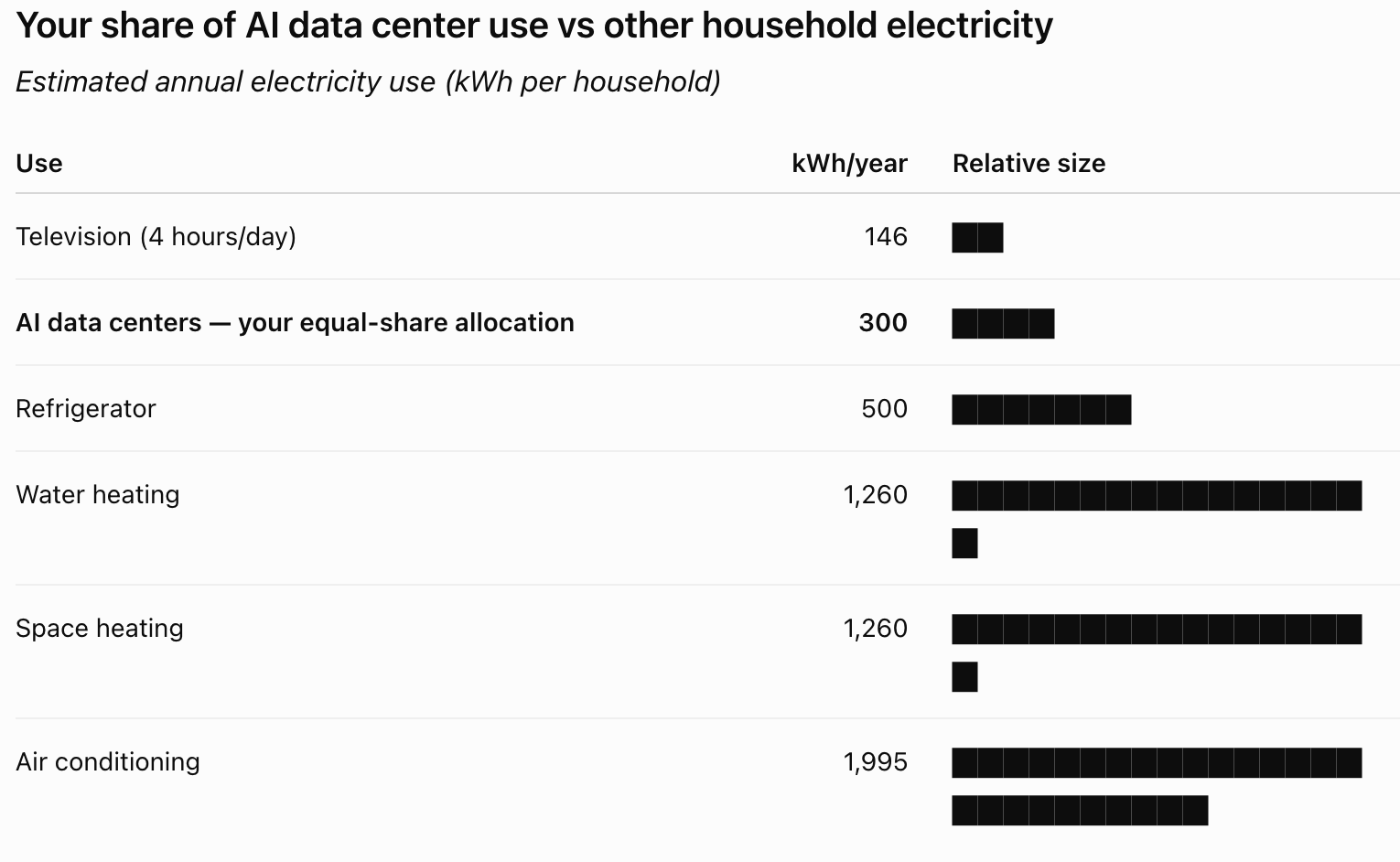
So the entire US AI industry, allocated across households, is currently equivalent to approximately:
- Two televisions running four hours a day.
- Roughly 60% of a refrigerator's annual electricity.
- About 15% of an average household's annual air-conditioning electricity.
- About 2–3.6% of an average household's total electricity consumption.
The distinction that matters
This is a considerably larger number than the electricity used by one person making 100 ChatGPT requests daily, because it distributes all US AI data-center consumption across everyone, including industrial and commercial AI.
It also changes the frame of the argument. AI's entire current US data-center electricity footprint is roughly equivalent to adding a modest household appliance to every home in America.
That is a meaningful demand for electricity, but it puts the current scale into perspective.
There are two qualifications: this is an equal-share national accounting comparison, not electricity that households personally consume or necessarily pay for; and the burden of data centers is geographically concentrated rather than evenly distributed.
Looking ahead, the latest Lawrence Berkeley National Laboratory projection puts all US data centers at 11.8% of national electricity in 2030, with AI servers accounting for 55% of data-center electricity. If that projection materializes, the AI share alone would be around 6.5% of US electricity—much larger than today.
So the current household-equivalent footprint is moderate, but the projected growth is substantial. That distinction gives us a much more grounded basis for discussing the environmental controversy.
give me the How that compares with household electricity chart with hed "Your share of AI data center use vs other household electricity"
Your share of AI data center use vs other household electricity
Estimated annual electricity use (kWh per household)
| Use | kWh/year | Relative size |
|---|---|---|
| Television (4 hours/day) | 146 | ██ |
| AI data centers — your equal-share allocation | 300 | ████ |
| Refrigerator | 500 | ███████ |
| Water heating | 1,260 | █████████████████ |
| Space heating | 1,260 | █████████████████ |
| Air conditioning | 1,995 | ██████████████████████████ |
Notes
- The AI data centers figure is the midpoint estimate from the prior calculation: ~225–375 kWh/year per household, with 300 kWh shown here as the central estimate. It represents total US AI data-center electricity spread evenly across all US households—not what a household literally uses directly.
- Water heating, space heating, and air conditioning are based on average household electricity shares from EIA data.
If you want, I can next turn this into:
- a clean LinkedIn-ready graphic/table, or
- a “with AI / without AI” side-by-side chart using the same framing.